From a Mosque to Neo-neolithic Apartments
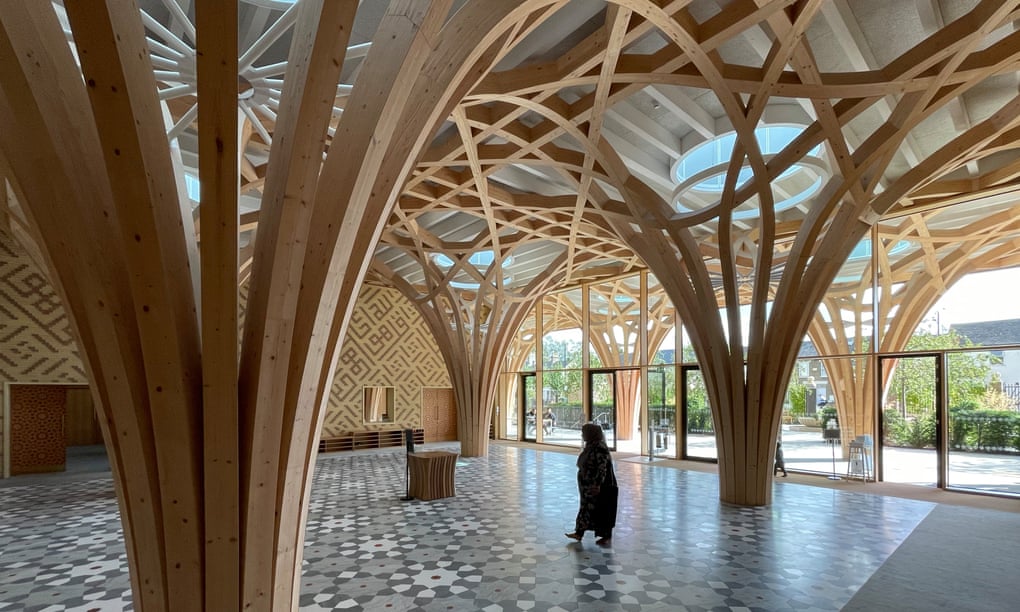
In this year's competition for the UK's finest new building, a mesmerizing wooden mosque in Cambridge will compete against a Cornish footbridge and a cluster of black boatsheds in the Lake District. A new student center for Kingston University, a major worker housing development in Cambridge, and a contentious stone apartment building in London that was almost destroyed by the local government are all in the running for the Riba Stirling award in 2021.
The mosque is both the most photogenic and the most likely to win the award. It was designed by Marks Barfield, the same firm that designed the London Eye ferris wheel, and it uses high-tech rigor to create a seductive glade of devotion.
A grid of towering tree-like columns branch outwards to create a filigree structural canopy that undulates over the prayer hall, mimicking the shape of gothic stone vaults and filtering sunshine from circular apertures above. The £23 million structure is a fascinating mix of local and Islamic traditions, producing a strong template for what a contemporary British mosque could be, with Cambridge Gault clay bricks patterned with beautiful Arabic Kufic inscriptions and ablution amenities worthy of a luxury spa.
The Tintagel Castle footbridge is an equally striking reinterpretation of a known style. The gossamer bridge, which spans a dramatic gulch that divides the Cornish mainland from the legendary location of Arthurian legend, shimmers like a dewy spider's web woven over the ravine.
The £5 million building seems eerily thin, tapering to nothing in the middle, where the two cantilevered sections meet with a tiny gap. It has an exceptionally handmade, tactile feel for a piece of infrastructure, according to Belgian bridge experts Ney & Partners and William Matthews (who supervised the design of Renzo Piano's Shard skyscraper).
The railings are constructed of raw wood, and the deck is covered with local slate tiles that have been packed together on their edges without cement, creating the impression of strolling over a box of After Eight mints while looking out over the pounding waves.
The Windermere Jetty Museum in the Lake District has a similar combination of raw and polished materials. The £20 million complex, designed by Carmody Groarke as a modest cluster of black metal huts, is a welcome change from the national park's typical emphasis on drystone walls and slate roofs.
The sheds' black-oxidised copper walls glisten with a subtle verdigris patina, while pieces have been cut out of their sides, leaving roofs floating with surreally deep overhangs, taking influence from boathouses and adjacent agricultural barns. The structures are lined with warm Douglas fir wood, mirroring the sleek pleasure boats on show, and are thoughtfully designed to frame views of the lake, enabling water to lap inside at times, attracting inquisitive swans and otters.
Kingston's £50 million Town House, a sumptuous new student facility in London, demonstrates the extent to which institutions are now willing to go to entice students in an increasingly competitive market. The building merges a library and dance studios into a dynamic, multi-story cathedral of collisions and connections, designed by Irish Pritzker Prize winners Grafton.
A wide stairway meanders around the structure, leading to a rooftop café with panoramic views over to Hampton Court Palace and the Thames, while quiet study spaces offer vertiginous views into the central performance space. A series of linked balconies cascade around the concrete-framed façade, enhancing the building's feeling of openness as a "learning landscape" intended to promote accidental meetings with other students — a pleasant possibility after months of online study.
After a daring municipal housing plan in Norwich took home the award last year, this year's shortlist included a pretty boring Cambridge University-funded housing project. The key worker flats by Stanton Williams, which are part of the new Eddington district, are inspired by the shape of the city's hallowed college courts.
The buff brick blocks create a number of free, interconnecting courtyards, which are linked by J&L Gibbons' highly diverse landscaping, which softens the harsh building.
It's well-made, with tidy bike racks and clever subterranean bin storage, but the whole impression is a little suffocating. It's a perpetually bland, lifeless area, possibly in thrall to the memory of Accordia, the Stirling Prize-winning housing complex on the other side of town from 2008, which has loomed big over most of the past decade's housing.
A unique social housing proposal by Peter Barber would have been a more intriguing addition to the shortlist (his projects have been confined to the separate Neave Brown award for housing instead, where they comprise two of the four contenders).
Finally, to provide some variety, there's a bizarrely unique structure that Islington council attempted to bulldoze. From afar, 15 Clerkenwell Close seems to be something Fred Flintstone could have built after seeing Mies van der Rohe's work.
Its façade is a square grid of columns and beams, but the components are monolithic slabs of limestone, plucked fresh from the quarry and sawn smooth, split, or drilled, with their masons' markings still visible. Stone is usually reduced to a thin ornamental veneer these days, but here it is holding the building up – which, according to architect and developer Amin Taha, is cheaper, quicker, and emits much less CO2 than a steel or concrete construction.
A contemporary ruin with creepers snaking their way up the rough stone structure is a truly lyrical sight. A collapsed column leans beside the entryway, its spiral carving mimicking the shape of an ammonite emerging from a slab above — a reference to a nunnery that formerly existed nearby, like the bronze scallop shells that adorn the gates.
An obsessive level of thought has gone into every detail, from the glass-box meeting room resting on an I-beam above Taha's basement office, to the intricate folding, sliding cabinetry of the apartments above, to a clever glass-topped lift shaft that eliminates the need for bulky mechanical ventilation.
All of this was insufficient for the council, which deemed the £5 million structure to be "rough, ugly, and detrimental to the conservation area," and issued a demolition notice, alleging it had violated its planning permit. A planning inspector ruled in Taha's favor after years of legal battle (which has delayed its Stirling shortlisting since 2018).
It would be sweet vengeance if this neo-neolithic masterpiece won the award, and its level of craftsmanship and ingenuity is unquestionably deserving. However, despite its advantages, it's difficult to see the judges choosing a customized private dream of eight luxury apartments above a project that contributes to a larger public good.
My money is on the mosque, which seems small on the exterior but has one of the most captivating interior spaces constructed this century, a modern-day King's College Chapel ceiling.
Thanks to Oliver Wainright at The Guardian whose reporting provided the original basis for this story.


