How Kyiv is protecting sculptures from Russian bombing using sandbag sculpture

The boarded-up monument to Taras Shevchenko in Kyiv. Photograph: Ed Ram/The Guardian
Unknown is the explosives' intended target, although others believe Russia is attempting to destroy significant Ukrainian sites.
The most powerful attacks on Kyiv's capital city since Moscow began its full-scale invasion of Ukraine have been conducted by Russia on two consecutive Mondays.
The only thing that is really evident about these missiles' intended objectives, assuming they were to hit vital infrastructure, is that they detonated in densely populated areas near parks, workplaces, and cultural institutions.
Two of the explosions from last week occurred so near to noteworthy national monuments that some people theorized that the sandbagged and guarded sculptures themselves may have been the intended targets.
A playground for kids was destroyed by one of the missiles only a few meters from a monument to Taras Shevchenko, the national poet of Ukraine. He was a key figure in the development of Ukrainian literature, but Tsar Nicholas I deported him and forbade him from writing or producing art for ten years. His monument, which was built in 1939, neatly took the place of an older statue of the same Russian tsar.
As part of a morning of Russian attacks on the city that left seven people dead and more than 50 wounded, another missile, falling on the other side of the park carrying Shevchenko's name, struck a road intersection. Additionally, it dispersed a hoarding guarding a monument honoring Mykhailo Hrushevsky, a politician and scholar who was a prominent member of the pre-revolutionary Ukrainian nationalist movement and the author of a ten-volume history of the nation.
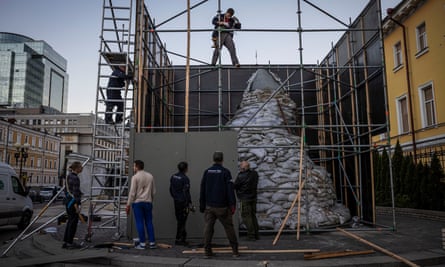
Workers fix hoarding around a statue of Mykhailo Hrushevsky. Photograph: Ed Ram/The Guardian
Along with an 11 p.m. curfew and the frequent sound of air raid sirens, Kyiv's monuments are one of the few reminders that this thriving city is at war. The statues have been sandbagged by the municipal government for security. They also give Kyiv a bizarre new aspect, as if modern artworks have been installed in place of the statues when they are boxed up, muffled, shrouded, and buried.
A monument honoring Dante Alighieri was unveiled in 2021 at Volodymyrska Hirka Park, where trails weave through forests above the Dnieper River, as a nod to western European culture as opposed to Russian culture. His carrara marble head, which is somewhat emaciated and melancholy, amusingly protrudes from above the sandbags.
He resembles Winnie from Samuel Beckett's darkly comedic play Happy Days, who is buried up to her neck. For the coal-black humor that so many Kyivans are expressing in the wake of the Russian invasion, Beckett does indeed seem quite fitting.
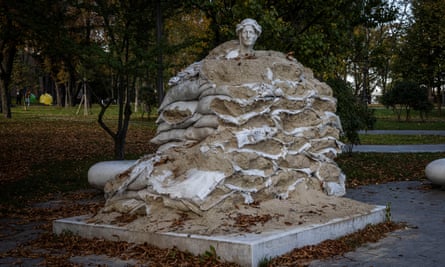
Sandbagged statue of Dante Alighieri in Volodymyrska Hirka Park. Photograph: Ed Ram/The Guardian
One of Kyiv's most contentious Soviet-era sculpture ensembles, debuted in 1982, is only a short distance away. A monument representing friendship between Russia and Ukraine served as its focal point. Over it, a huge metal arch was built in remembrance of what the Soviets called the "reunification" of Russia and Ukraine in 1654.
A granite sculpture was erected next to the arch, showing the council of Pereislav, not the so-called "reunification" as portrayed by Soviet propaganda, but rather the meeting when the Cossack Bohdan Khmelnytsky pledged loyalty to Muscovy in exchange for safety.
Unsurprisingly, the twin sculptures representing Russia and Ukraine were joyously removed in April of this year. This action required the beheading of one of the figurines, leaving the plinth disfigured.
This May, the arch received a new name: the Arch of Freedom of the Ukrainian People. It had previously been called the Arch of Friendship after the dissolution of the Soviet Union and painted with a sizable black symbolic crack in 2018.
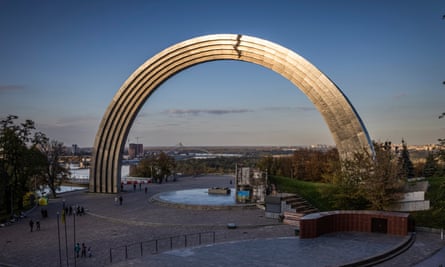
The Arch of Freedom, with boxed-up sculpture beneath it. Photograph: Ed Ram/The Guardian
Since then, the granite sculpture of the council of Pereislav has been boxed up in a plywood construction that has weathered to a deep grey patina. In this instance, the goal is to conceal the artwork from the public until it can be removed rather than to defend it from Russian missiles. If it weren't for the Ukrainian flag that someone painted on the side, it would seem like a sculpture by Rachel Whiteread.
Saint Volodymyr, who converted Kyivan Rus to Christianity at the beginning of the first millennium CE, is nearby and still clearly seen waving his cross over the Dnieper below. The only thing protected is his intricately carved plinth. But at Mykhailivska Square, his legendary grandmother Olha, a Kyivan ruler who in the 10th century outsmarted her rivals to maintain control of the budding city, has been completely sandbagged.
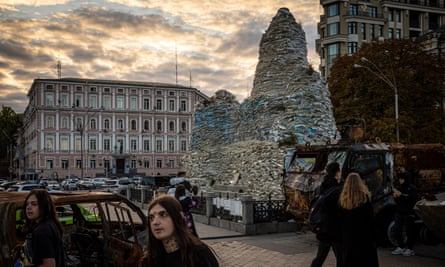
Covered-up statue of Olha in Mykhailivska Square. Photograph: Ed Ram/The Guardian
The monument now has an Anselm Kiefer-esque feel about it. The national military history museum of Ukraine has painstakingly labeled burnt-out Russian tanks and other seized vehicles that are on exhibit next to it. Protest banners are draped over it, and plants have already begun to emerge from the sandbags.
A similar contrast of old and modern may be seen at the nearby Sophia Square. The top of Bohdan Khmelnytsky's head, wrapped in green cloth and bound with scarlet, can barely be made out peeking above the boards and scaffold.
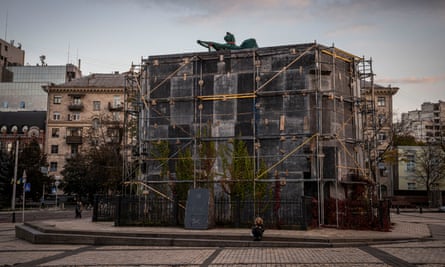
Bohdan Khmelnytsky in Sophia Square. Photograph: Ed Ram/The Guardian
But a new monument that troops built on Thursday afternoon is drawing greater attention. By Friday, pilgrims had already gathered to pay their respects, adorning the memorial with sunflowers and other tributes in addition to the straightforward display of big images of Azov battalion men slain during the Mariupol siege.
The impressive equestrian statue honoring Mykola Shchors is one public artwork in Kyiv that is not covered with sandbags or boxes and has no other kind of protection. The Ukrainian officer served in the Red Army against the short existing autonomous Ukrainian People's Republic from 1917 to 1920.
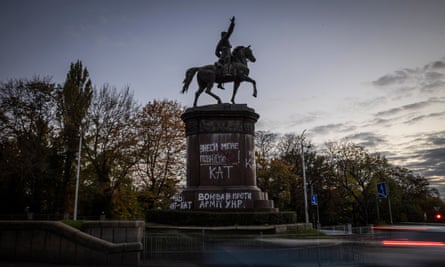
Graffitied statue dedicated to Mykola Shchors. Photograph: Ed Ram/The Guardian
Graffiti written on the monument includes phrases like "demolish me entirely! as well as "butcher." Many individuals in Kyiv would not care at all if one of Vladimir Putin's missiles were to strike that location.
Thanks to Charlotte Higgins at The Guardian whose reporting provided the original basis for this story.


