Ken Howard obituary

Known as "the last impressionist," this well-known and prolific painter was
Detail of The Grand Canal from the Accademia Bridge, 2018, by Ken Howard, who kept a studio in Venice. Photograph: Courtesy of Portland Gallery
The Imperial War Museum dispatched Ken Howard to chronicle the Troubles in Northern Ireland in 1973 as a war artist in everything but name. (According to political rhetoric of the day, the bloodshed in the province did not amount to war.) Howard was surprised to discover that his practice of painting outside helped him make friends on all sides of the sectarian spectrum. He said, "If you used a camera, you were in trouble." "You weren't in trouble if you sat on the sidewalk and drew, and they could see what you were doing."
According to Howard, an IRA member on the Falls Road biddably blew up a vehicle to make it more scenic for his brush. But the subject of his most well-known piece was a little kid he spotted hanging from a lamp post.
Ulster Crucifixion (1978), a gothic altarpiece with a center panel, folding wings, and a predella, is now on display in the Ulster Museum of the National Museums Northern Ireland. Its background's unfinished paint both mimics and recalls the graffiti-covered walls of west Belfast. Its little kid seems to be hanging from a cross from the post.
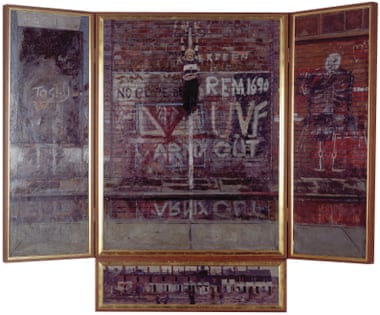
Ken Howard’s 1978 work Ulster Crucifixion is in the style of a gothic altarpiece. Photograph: The estate of Ken Howard, Ulster Museum Collection
Even while Ulster Crucifixion became Howard's best-known piece, it was by no means his most typical. Its flavor had a little Francis Bacon flavor; Claude Monet's tang was far more prevalent. Howard, who passed away at the age of 89, was proud to call himself "the last impressionist," much to the dismay of elitist critics and a newer generation of British painters. He described himself as "a painter of light" and had studios in Mousehole, Cornwall, Venice, west London's public squares (locals called him "High Street Ken" since he often drew on the street), and Venice.
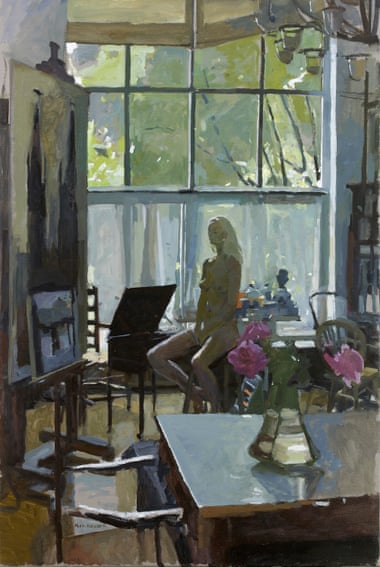
Works like Honesty and Charlotte (1990), created at his Chelsea workshop, are typical of this method. The eponymous vase of white seed pods in the composition's center serves as inspiration for the canvas's dappled colors, which were painted contre-jour, or against the light of day. The picture's topic is the reflection of light off wallpaper, clothing, glass, and human flesh; the Sickertian nude almost looks accidental. The same is true for Howard's many portrayals of Venice and Mousehole. The only location on earth that has lighting conditions comparable to Venice is Mousehole, he said.
It hadn't always been so sunny in his uplands. The younger of the two children of Frank, a mechanic from Lancashire, and Elizabeth (née Meikle), a Scot who worked as a cleaner, Howard was born in the north-west London neighborhood of Neasden. He remembers "painting properly from the age of seven and drawing and painting before I could write."
The young Ken was urged to apply to the neighboring Hornsey College of Art by an art teacher at Kilburn Grammar School, where he attended from 1949 to 1953. National service in the Royal Marines and two years at the Royal College of Art came next (1955-57).
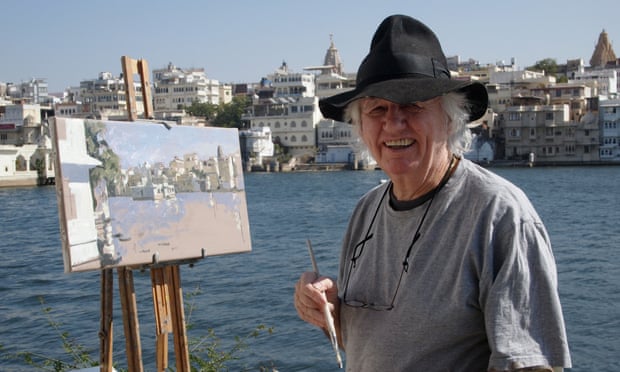
Ken Howard, painting en plein air in Rajasthan, India. He was, he said, ‘a painter of light’. Photograph: Dora Bertolutti Howard/Gabriel Fine Arts
By that time, Howard had already experienced the social realism and kitchen-sink painting fads. "I painted Neasden and power stations," he remembered. Both had to some extent been successful for him. The picture David Brown, the future owner of Aston Martin, purchased was of the shipyards in Aberdeen, where he had been driven by a lorry-driving uncle shortly after the war.
Howard believed that his early exposure to industrial grit had influenced his painting, despite his subsequent preference for sunshine and the sea. I was raised among the horizontal and vertical buildings of industries and railroad yards, he said. "I am a vertical and horizontal painter, not a landscape painter."
This was evident in Ulster Crucifixion's composition, but less so in Howard's other paintings of beaches, cathedrals, and Venetian canals. His Royal College classmates were enamored with abstract expressionism when he enrolled there. Howard said, "America had arrived just before I did. "I started to feel a little off balance."
For the remainder of his life, he would continue to be outside the mainstream of fashion. His work was metaphorical and unabashedly pleasing, and to critics like the late Brian Sewell it was sugary, regardless of its logical basis. Aside from his job with the British Army, Howard joyfully acknowledged that it also seemed to never change. He remarked, "I'm one of those individuals that keeps hammering at the same nail. He participated in the Royal Academy's Summer Exhibition for many years, but it wasn't until he was over 60 that he was given full academician status.
Above all, he idolized Turner, and not simply for the "visual genius" he claimed the master had. Howard said, "I enjoy the concept that, like Turner, I'm from a working-class background.
He recreated his hero's adventures through Switzerland in the 2010s over the course of five visits of his own, creating 100 colossal canvases of Swiss Alps and Lakes as well as the book Ken Howard's Switzerland: In the Footsteps of Turner. He had been named the Royal Academy's professor of perspective in 2004, after Turner, and he retained that post until 2010. He became a patron of the Turner's House Trust in 2017.
All of this made it easier to handle dismissing detractors like Sewell and to accept the OBE in 2010. Success financially also lessened the blow. Howard made up for the fact that his art never attained the types of prices that his more avant-garde predecessors did by being both prolific and well-liked. He used to remark, "I've got more paintings on people's walls than any other painter alive today." He was not given to contemplation since he was short, jovial, and fond of theatrical capes and hats.
He also had a keen sense of real estate. For six pounds a week, Howard hired his Chelsea studio—previously the workshop of Edwardian social portraitist William Orpen—in 1973. He spent the next 30 years purchasing both it and the huge mansion it was housed in, which, at the time of his death, was worth several million pounds. Howard smiled, "My mom always used to joke that if I went into the toilet, I'd come up with a bar of chocolate. That, in my opinion, pretty well sums it up.
He wed three times: first, in 1962, to fashion designer Annie Popham; second, in 1990, to Hamburg-born painter Christa Gaa Köhler, whom he had met in Florence in the 1950s; and third, in 2000, to Italian photographer Dora Bertolutti. All three marriages ended in divorce in 1974. Along with a stepson and two stepdaughters, she survives him.
James Kenneth Howard, painter, born 26 December 1932; died 11 September 2022
Thanks to Charles Darwent at The Guardian whose reporting provided the original basis for this story.


